No, it’s not bad grammar. It’s what I meant to say. But it’s highly specific and you’ll get it if you read on.
If you’ve read Study the Bible – Six Easy Steps, you’ll know that in the book I lay out a bunch of ways to “study the Bible” that don’t require a ton of skill or learning:
- Reading your Bible….
- Meditating on Scripture…
- Memorizing God’s Word…
When it comes to God’s Word, the critical element is that we ENGAGE with it.
If you’ve been around for a while, you know it only takes a feather drop to get me on a soapbox about reading your Bible. I’ll restrain myself on that today.
But for a long time, I’ve been wanting to get back into Scripture memorization. When I was a youngster, I did a lot of memorization through the AWANA program. That memorization – scripture committed to memory by heart – has served me well throughout my life.
So what do I want to memorize? The book of Ephesians. It’s a rich book full of theological truth. But it’s also short – only 6 chapters. so it seemed like a reasonable task.
I just did a check and it has 155 verses and 3022 total words. I know the script for a play is often much longer – the Phantom of the Opera complete script is over 14,000 words! That’s my way of saying “If Michael Crawford can memorize his lines as the Phantom, then I can memorize Ephesians!”
I’ve wanted to do this for a long while. I’ve tried to do traditional recitation repetition memorization. Not much luck there. But then I didn’t really try hard.
One of the things my wife does in her daily devotions is to write out portions of scripture in a journal. That sounded intriguing. So I bought a little notebook and mid-month I started writing out Ephesians chapter 1. Almost every day. (I’m practicing grace with myself when I miss a day).
This practice has given me a lot to say. But I won’t say it all now. You might hear more about Ephesians in and upcoming note…
What I will say… I practice the habit of capitalizing divine pronouns. It’s common practice to capitalize God when referring to God the Father. But I also capitalize all pronouns referring to God, Jesus or the Holy Spirit (so much so, I have programmed special keystrokes on my iPhone to automatically apply the capitalization when referring to God).
Going through Ephesians 1, let me tell you that’s a lot of Divine Pronouns! I found myself really having to pay attention to the context to keep track of who is referring to what (or whom). I really want to be respectful to the name of God. I get upset if I look back and find a Him or His that missed.
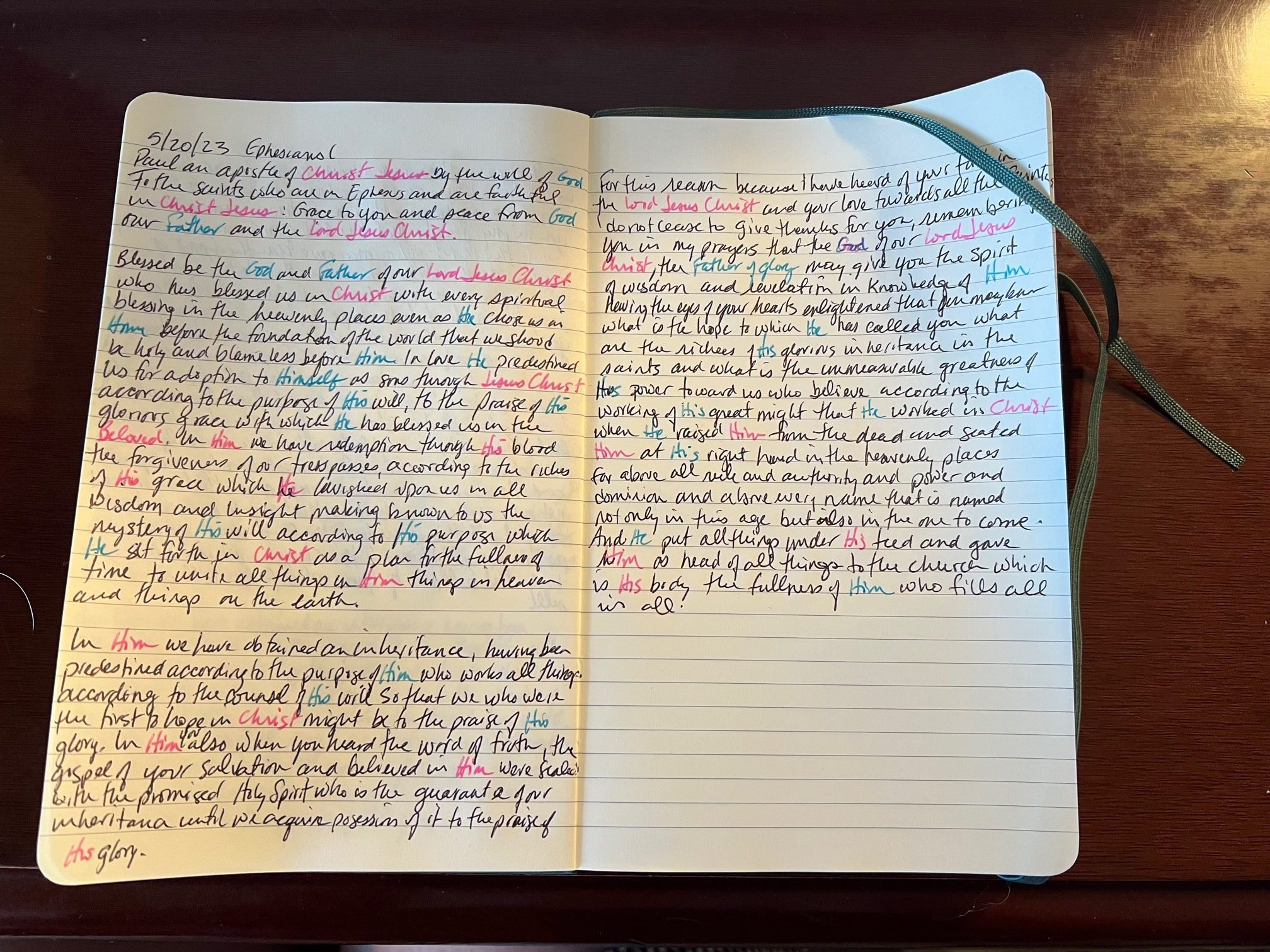
But in some parts of Ephesians 1 it gets pretty think and it can be hard to tell if the word “Him” is referring back to God or Jesus. So much so, it became a challenge for me as I was writing it out. So I upped the ante a little and decided to color code my references to the members of the Trinity. The “God the Father” and “Lord Jesus Christ” are really easy to figure out. But when the word “He” or “Him” occurs multiple times in the space of just a few words, it can be challenging.
Hence the subject line of this email: Who is “Him”?
I took a picture one day, thinking it was a fun thing to do. Now I’m sharing it with you: Picture of Ephesians 1
So what’s the point?
Only that there are a lot of ways to interact with God’s word. As Jesus’ disciples, we need to make a big deal about Him and what He said. We can only do that by going to our Bibles.
This is not about how great I am. I’ve missed doing my assignment a bunch of days already. I have yet to really “memorize” the whole chapter. So this is an experiment with a very uncertain outcome for me. But even if I never get to the memorization goal, I do know I will be blessed for having spent time interacting with, thinking about, dwelling on the eternal Word of God.
Personally, I hope this inspires you to do something new and creative with your Bible. If not, I’ll have a few more emails that will give you even more to think about on this topic.
Until next time,
Dennis